
Profile
|
Publications
Real-Time Isosurface Extraction with View-Dependent Level of Detail and Applications
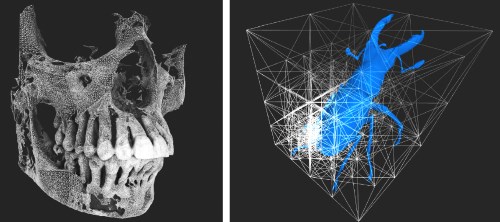
Volumetric scalar datasets are common in many scientific, engineering, and medical applications where they originate from measurements or simulations. Furthermore, they can represent geometric scene content, e.g. as distance or density fields. Often isosurfaces are extracted, either for indirect volume visualization in the former category, or to simply obtain a polygonal representation in case of the latter. However, even moderately sized volume datasets can result in complex isosurfaces which are challenging to recompute in real-time, e.g. when the user modifies the isovalue or when the data itself is dynamic. In this paper, we present a GPU-friendly algorithm for the extraction of isosurfaces, which provides adaptive level of detail rendering with view-dependent tessellation. It is based on a longest edge bisection scheme where the resulting tetrahedral cells are subdivided into four hexahedra, which then form the domain for the subsequent isosurface extraction step. Our algorithm generates meshes with good triangle quality even for highly nonlinear scalar data. In contrast to previous methods, it does not require any stitching between regions of different levels of detail. As all computation is performed at run-time and no preprocessing is required, the algorithm naturally supports dynamic data and allows us to change isovalues at any time.
@article{SBD2015,
title = {Real-Time Isosurface Extraction with View-Dependent Level of Detail and Applications},
author = {Manuel Scholz and Jan Bender and Carsten Dachsbacher},
year = {2015},
volume = {34},
pages = {103--115},
number = {1},
doi = {10.1111/cgf.12462},
issn = {1467-8659},
journal = {Computer Graphics Forum},
url = {http://dx.doi.org/10.1111/cgf.12462}
}
Level of Detail for Real-Time Volumetric Terrain Rendering
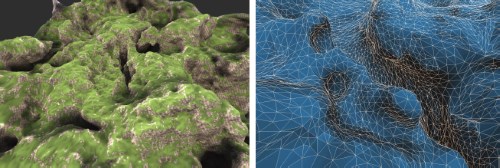
Terrain rendering is an important component of many GIS applications and simulators. Most methods rely on heightmap-based terrain which is simple to acquire and handle, but has limited capabilities for modeling features like caves, steep cliffs, or overhangs. In contrast, volumetric terrain models, e.g. based on isosurfaces can represent arbitrary topology. In this paper, we present a fast, practical and GPU-friendly level of detail algorithm for large scale volumetric terrain that is specifically designed for real-time rendering applications. Our algorithm is based on a longest edge bisection (LEB) scheme. The resulting tetrahedral cells are subdivided into four hexahedra, which form the domain for a subsequent isosurface extraction step. The algorithm can be used with arbitrary volumetric models such as signed distance fields, which can be generated from triangle meshes or discrete volume data sets. In contrast to previous methods our algorithm does not require any stitching between detail levels. It generates crack free surfaces with a good triangle quality. Furthermore, we efficiently extract the geometry at runtime and require no preprocessing, which allows us to render infinite procedural content with low memory consumption.
» Show BibTeX
@inproceedings{Scholz2013,
author = {Manuel Scholz and Jan Bender and Carsten Dachsbacher },
title = {{Level of Detail for Real-Time Volumetric Terrain Rendering}},
pages = {211-218},
URL = {http://diglib.eg.org/EG/DL/PE/VMV/VMV13/211-218.pdf},
DOI = {10.2312/PE.VMV.VMV13.211-218},
editor = {Michael Bronstein and Jean Favre and Kai Hormann},
booktitle = {VMV 2013: Vision, Modeling & Visualization},
year = {2013},
address = {Lugano, Switzerland},
publisher = {Eurographics Association}
}
Perspective Accurate Splatting
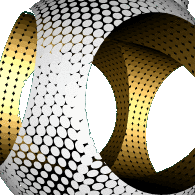
We present a novel algorithm for accurate, high quality point rendering, which is based on the formulation of the splatting process using homogeneous coordinates. In contrast to previous methods, this leads to perspective correct splat shapes, avoiding artifacts such as holes due to the approximation of the perspective projection. Further, our algorithm implements the EWA resampling filter, hence providing high image quality with anisotropic texture filtering. We also present an extension of our rendering primitive that allows the display of sharp edges and corners. Finally, we describe an efficient implementation of the algorithm based on vertex and fragment programs of current GPUs.
