
Publications
Freeform Shape Fabrication by Kerfing Stiff Materials

Fast, flexible, and cost efficient production of 3D models from 2D material sheets is a key component in digital fabrication and prototyping. In order to achieve high quality approximations of freeform shapes, a common set of methods aim to produce bendable 2D cutouts that are then assembled. So far bent surfaces are achieved automatically by computing developable patches of the input surface, e.g. in the context of papercraft. For stiff materials such as medium-density fibreboard (MDF) or plywood, the 2D cutouts require the application of additional cutting patterns (“kerfing”) to make them bendable. Such kerf patterns are commonly constructed with considerable user input, e.g. in architectural design. We propose a fully automatic method that produces kerfed cutouts suitable for the assembly of freeform shapes from stiff material sheets. By exploring the degrees of freedom emerging from the choice of bending directions, the creation of box joints at the patch boundaries as well as the application of kerf cuts with adaptive density, our method is able to achieve a high quality approximation of the input.
@article{speetzen2024freeform,
title={Freeform Shape Fabrication by Kerfing Stiff Materials},
author={Speetzen, Nils and Kobbelt, Leif},
year = {2024},
journal = {Computer Graphics Forum},
volume = {43},
number = {2},
}
Choose Your Reference Frame Right: An Immersive Authoring Technique for Creating Reactive Behavior

Immersive authoring enables content creation for virtual environments without a break of immersion. To enable immersive authoring of reactive behavior for a broad audience, we present modulation mapping, a simplified visual programming technique. To evaluate the applicability of our technique, we investigate the role of reference frames in which the programming elements are positioned, as this can affect the user experience. Thus, we developed two interface layouts: "surround-referenced" and "object-referenced". The former positions the programming elements relative to the physical tracking space, and the latter relative to the virtual scene objects. We compared the layouts in an empirical user study (n = 34) and found the surround-referenced layout faster, lower in task load, less cluttered, easier to learn and use, and preferred by users. Qualitative feedback, however, revealed the object-referenced layout as more intuitive, engaging, and valuable for visual debugging. Based on the results, we propose initial design implications for immersive authoring of reactive behavior by visual programming. Overall, modulation mapping was found to be an effective means for creating reactive behavior by the participants.
Honorable Mention for Best Paper!» Show BibTeX
@inproceedings{eroglu2024choose,
title={Choose Your Reference Frame Right: An Immersive Authoring Technique for Creating Reactive Behavior},
author={Eroglu, Sevinc and Schmitz, Patric and Sinke, Kilian and Anders, David and Kuhlen, Torsten Wolfgang and Weyers, Benjamin},
booktitle={30th ACM Symposium on Virtual Reality Software and Technology},
pages={1--11},
year={2024}
}
Generalizing feature preservation in iso-surface extraction from triple dexel models
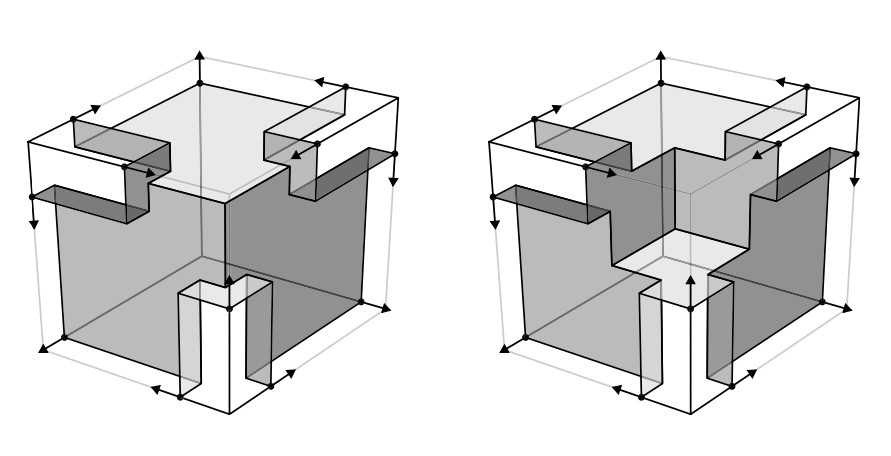
We present a method to resolve visual artifacts of a state-of-the-art iso-surface extraction algorithm by generating feature-preserving surface patches for isolated arbitrarily complex, single voxels without the need for further adaptive subdivision. In the literature, iso-surface extraction from a 3D voxel grid is limited to a single sharp feature per minimal unit, even for algorithms such as Cubical Marching Squares that produce feature-preserving surface reconstructions. In practice though, multiple sharp features can meet in a single voxel. This is reflected in the triple dexel model, which is used in simulation of CNC manufacturing processes. Our approach generalizes the use of normal information to perfectly preserve multiple sharp features for a single voxel, thus avoiding visual artifacts caused by state-of-the-art procedures.
Retargeting Visual Data with Deformation Fields
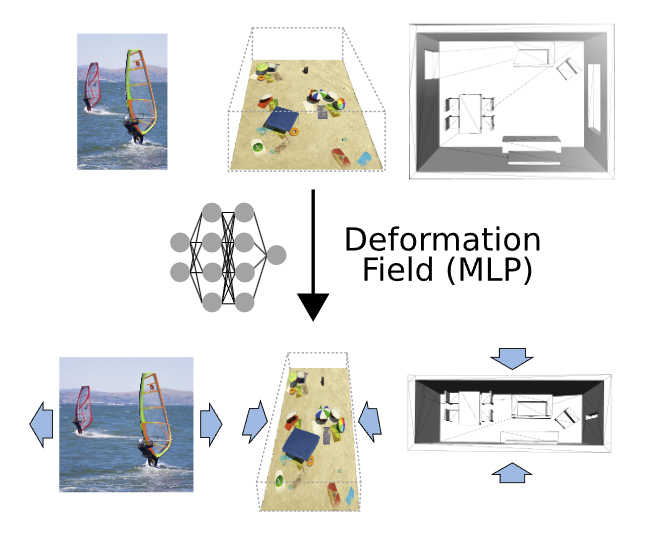
Seam carving is an image editing method that enables content- aware resizing, including operations like removing objects. However, the seam-finding strategy based on dynamic programming or graph-cut lim- its its applications to broader visual data formats and degrees of freedom for editing. Our observation is that describing the editing and retargeting of images more generally by a deformation field yields a generalisation of content-aware deformations. We propose to learn a deformation with a neural network that keeps the output plausible while trying to deform it only in places with low information content. This technique applies to different kinds of visual data, including images, 3D scenes given as neu- ral radiance fields, or even polygon meshes. Experiments conducted on different visual data show that our method achieves better content-aware retargeting compared to previous methods.
Previous Year (2023)
