
Profile

|
Publications
Interactive Simulation of Aircraft Noise in Aural and Visual Virtual Environments
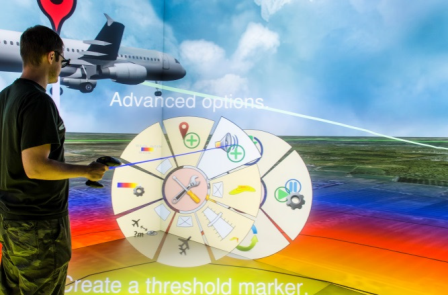
This paper describes a novel aircraft noise simulation technique developed at RWTH Aachen University, which makes use of aircraft noise auralization and 3D visualization to make aircraft noise both heard and seen in immersive Virtual Reality (VR) environments. This technique is intended to be used to increase the residents’ acceptance of aircraft noise by presenting noise changes in a more directly relatable form, and also aid in understanding what contributes to the residents’ subjective annoyance via psychoacoustic surveys. This paper describes the technique as well as some of its initial applications. The reasoning behind the development of such a technique is that the issue of aircraft noise experienced by residents in airport vicinities is one of subjective annoyance. Any efforts at noise abatement have been conventionally presented to residents in terms of noise level reductions in conventional metrics such as A-weighted level or equivalent sound level Leq. This conventional approach however proves insufficient in increasing aircraft noise acceptance due to two main reasons – firstly, the residents have only a rudimentary understanding of changes in decibel and secondly, the conventional metrics do not fully capture what the residents actually find annoying i.e. characteristics of aircraft noise they find least acceptable. In order to allow least resistance to air-traffic expansion, the acceptance of aircraft noise has to be increased, for which such a new approach to noise assessment is required.
Virtual Air Traffic System Simulation - Aiding the Communication of Air Traffic Effects
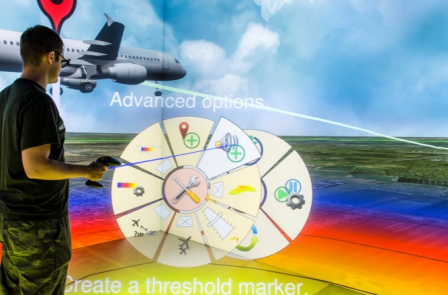
A key aspect of air traffic infrastructure projects is the communication between stakeholders during the approval process regarding their environmental impact. Yet, established means of communication have been found to be rather incomprehensible. In this paper we present an application that addresses these communication issues by enabling the exploration of airplane noise emissions in the vicinity of airports in a virtual environment (VE). The VE is composed of a model of the airport area and flight movement data. We combine a real-time 3D auralization approach with visualization techniques to allow for an intuitive access to noise emissions. Specifically designed interaction techniques help users to easily explore and compare air traffic scenarios.
Virtual Reality System at RWTH Aachen University
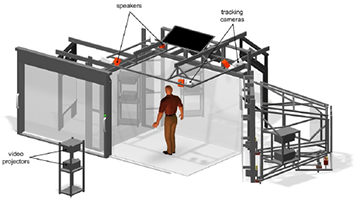
During the last decade, Virtual Reality (VR) systems have progressed from primary laboratory experiments into serious and valuable tools. Thereby, the amount of useful applications has grown in a large scale, covering conventional use, e.g., in science, design, medicine and engineering, as well as more visionary applications such as creating virtual spaces that aim to act real. However, the high capabilities of today’s virtual reality systems are mostly limited to firstclass visual rendering, which directly disqualifies them for immersive applications. For general application, though, VR-systems should feature more than one modality in order to boost its range of applications. The CAVE-like immersive environment that is run at RWTH Aachen University comprises state-of-the-art visualization and auralization with almost no constraints on user interaction. In this article a summary of the concept, the features and the performance of our VR-system is given. The system features a 3D sketching interface that allows controlling the application in a very natural way by simple gestures. The sound rendering engine relies on present-day knowledge of Virtual Acoustics and enables a physically accurate simulation of sound propagation in complex environments, including important wave effects such as sound scattering, airborne sound insulation between rooms and sound diffraction. In spite of this realistic sound field rendering, not only spatially distributed and freely movable sound sources and receivers are supported, but also modifications and manipulations of the environment itself. The auralization concept is founded on pure FIR filtering which is realized by highly parallelized non-uniformly partitioned convolutions. A dynamic crosstalk cancellation system performs the sound reproduction that delivers binaural signals to the user without the need of headphones. The significant computational complexity is handled by distributed computation on PCclusters that drive the simulation in real-time even for huge audio-visual scenarios.
@inproceedings{schroder2010virtual,
title={Virtual reality system at RWTH Aachen University},
author={Schr{\"o}der, Dirk and Wefers, Frank and Pelzer, S{\"o}nke and Rausch, Dominik and Vorl{\"a}nder, Michael and Kuhlen, Torsten},
booktitle={Proceedings of the international symposium on room acoustics (ISRA), Melbourne, Australia},
year={2010}
}
